
Injury Insights: Research (June 2026)

[Cover photo: Young child running through Syrian refugee camp in daylight.]
Our Injury Insights: Research series highlights a selection of recent publications by BCIRPU researchers.
The impact of recreational cannabis legalization on pediatric emergency department visits in British Columbia, Canada (April 2026)
Authors: Melody Xiao, Aygun Ibrahimova, Atousa Zargaran, Phoebe Cheng, Mojgan Karbakhsh, Fahra Rajabali, Kate Turcotte, Kirvy Quiambao, and Shelina Babul
Following the legalization of non-medical cannabis in Canada in October 2018, concerns were raised about potential increases in cannabis exposures and unintentional poisonings among children and youth aged 16 years and younger.
To investigate the impact of cannabis legalization, researchers examined trends in cannabis-related pediatric emergency department (ED) visits at BC Children’s Hospital from 2016 to 2021. Before legalization, the number of ED visits for cannabis poisoning increased each year, with a total of 119 cases during this time period. In the three-month period immediately after legalization, there was an immediate further increase in cases. The number of visits then decreased each year in the three-year period after legalization—but the total number of cases was higher than pre-legalization at 185 cases. The majority of visits involved intentional cannabis use among youth aged 14–16 years, and unintentional use of edible cannabis products was most common among younger children,.
These findings highlight the need for strengthened prevention measures, public education, and ongoing surveillance to reduce cannabis-related exposures and harm among children and youth, particularly involving edible products.
Read more in the journal Health Promotion and Chronic Disease Prevention in Canada, and view our summary infographic on the project (PDF).
Child maltreatment cases in Ontario and British Columbia during the pandemic: A comparative study (July 2026)
Authors: Kelvin Bo Him Cho, Fahra Rajabali, Shazya Karmali, Steve McFaull, Aimée Campeau, Brendan Smith, Sarah Carsley, Ian Pike, Alison Macpherson, and Sarah A. Richmond
The conditions of the COVID-19 pandemic introduced new stressors, including economic instability, modified social interactions, and the exacerbation of existing vulnerabilities, potentially increasing the risk of violence against children.
Researchers investigated the types of child maltreatment and contextual factors experienced by children and youth presenting with injuries to children’s hospital emergency departments during the pandemic, compared to pre-pandemic, in Ontario and British Columbia (BC). They observed no significant change in the number of emergency department visits in BC, but a significant decrease in visits in Ontario. Both provinces showed shifts in child maltreatment risks from public spaces to homes, which influenced the types of maltreatment, as well as the perpetrators and settings involved.
This study sheds light on how changes in family and social circumstances influence child maltreatment trends, highlighting the need for enhanced supports for families during public health emergencies.
Read more in the journal Child Abuse & Neglect.
Play as nostalgic reminiscence and escapism during the 2024 war on Lebanon: The meaning of play to internally displaced Lebanese children through art and memory (anticipated July 2026)
Authors: Michelle E. E. Bauer, Noor Srour, Hawraa Chahine, Farah El-Hajj, Shaymaa Barakat, Leyla Akoury Dirani, and Samar Al-Hajj
One in five children globally live in areas affected by armed conflict, with devastating consequences for their health and development—including through the loss of safe opportunities for play. Identifying ways to support play in post-displacement environments is important to support trauma recovery and resilience-building in unfamiliar environments and communities.
To explore the meaning of play to these children, and identify opportunities to support safe play in temporary settlements, researchers from BCIRPU and the American University of Beirut conducted arts-based interviews with 27 Lebanese children who had been internally displaced due to the 2024 Israeli war on Lebanon. They found that the meaning of play for these children was deeply tied to feelings of nostalgic reminiscence, safety, and escapism.
The researchers' findings illustrate how memories of play act as a coping mechanism for children displaced due to armed conflict, with children finding comfort in remembering how and what they played before war. However, the absence of safe play spaces contributed to children’s psychological distress and loss of identity. Researchers advocate for supporting internally displaced children by incorporating green and natural spaces into temporary settlements, and recognizing safe play as an essential tool for encouraging coping, trauma recovery post-displacement, and identity reclamation.
Read more in The International Journal of Play.
Violence against children in Syrian refugee camps and villages: The need for equitable solutions to a growing global health crisis (April 2026)
Authors: Michelle E. E. Bauer, Jana Abdelhameed, Elise Presser, Ian Pike, and Samar Al-Hajj
Children living in refugee settlement areas face a high risk of experiencing violence. To better understand families' lived experiences and perspectives on violence against children in these areas, researchers conducted semi-structured interviews with 90 Syrian families in refugee camps and villages across Lebanon.
Findings illuminated the disproportionate burden of violence experienced by Syrian refugee children due to discriminatory and stigmatizing beliefs about refugee populations and sexual assaults. The researchers call for targeted interventions to mitigate xenophobia and gender-based discrimination in refugee settlement areas, and encourage safe reporting and policing. Authors advocate for the continued use of trauma- and violence-informed prevention lenses to address these and other issues refugee families face in keeping children safe in conflict and war zones.
Read more in the journal Child: Care, Health and Development.
‘There are so many good things outside, let me tell you’: Children’s qualitative perspectives of outdoor play affordances at early learning and child care (April 2026)
Authors: Rachel Ramsden, Emily Jenkins, Sally Thorne, Ian Pike, and Mariana Brussoni
Participation in outdoor play in early childhood has been shown to positively influence long-term health and development, and early learning and child care (ELCC) centres are important settings for children to engage in these activities.
Researchers recruited twenty children aged 3-5 years to participate in observations, child interviews, child-led tours, and map-making exercises, in order to understand their thoughts about play features in ELCC centres. Through this work, they identified environmental features that contributed to physical, social, imaginative, and nature play opportunities, including sandboxes, tricycle paths, gardening areas, playhouses, climbing structures, water features, mud kitchens, and stumps and logs.
This study highlights how integrating traditional and natural play features, including accessible sensory elements, and providing diverse levels of challenge can enhance play at ELCC centres. This research also allowed young children to participate in research in a meaningful way.
Read more in the Journal of Early Childhood Research.
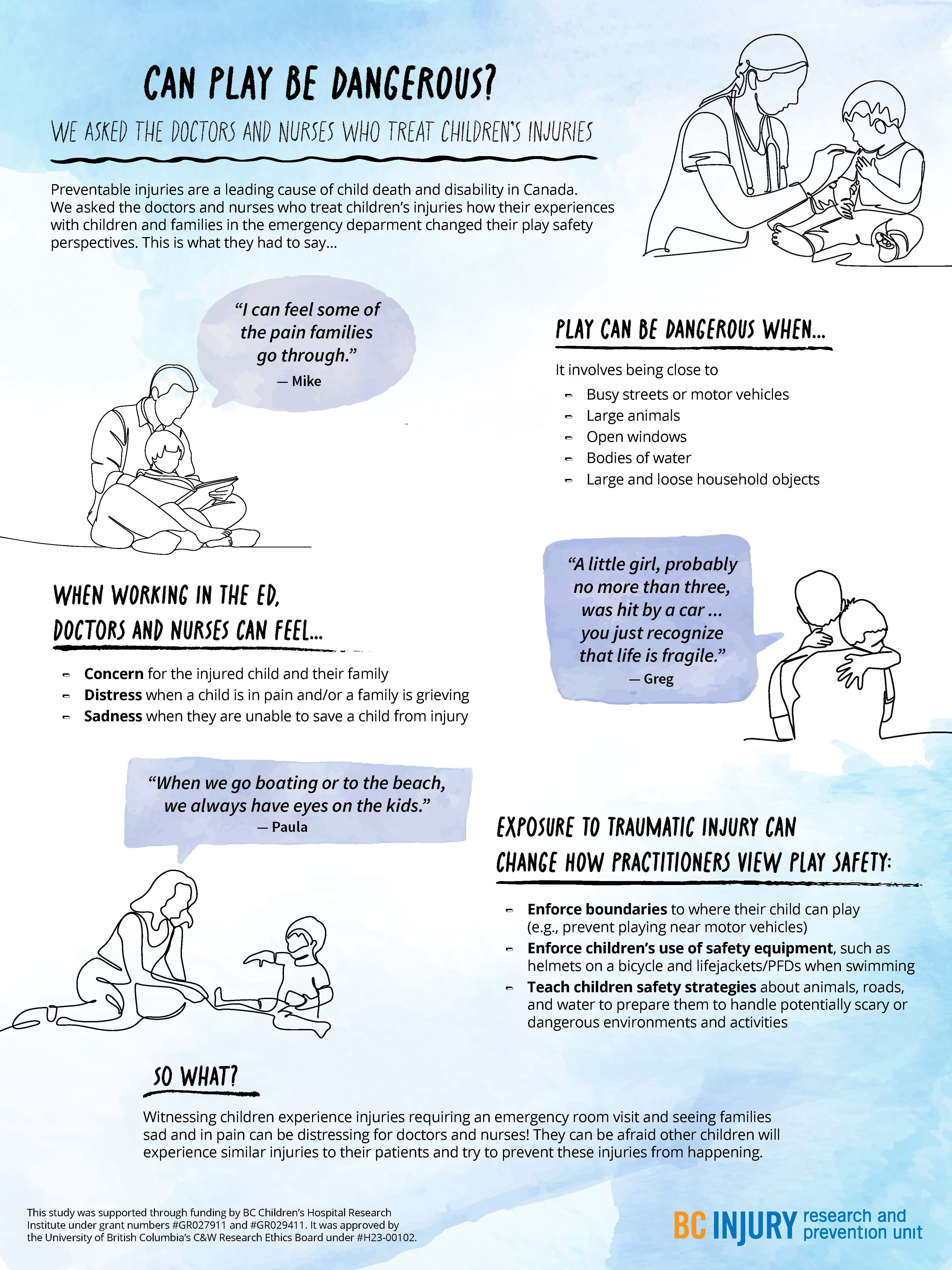
- distress when a child was in pain and when a family was grieving; and
- sadness in the event they were not able to save a child in their care.
- concern for the injured child and the child’s family;
Particularly traumatic events, such as those involving vivid sights and sounds (e.g., families holding each other and having extreme reactions), stuck with the practitioners, having long-lasting impressions on them and causing them to re-live these events in the years following their exposure.
Even after their shift was over, practitioners said that they changed how they approached parenting and how they perceived safety during play as a result of witnessing these traumatic events. They reported having more knowledge of the causes and consequences of severe injuries, such as those that require hospitalization or emergency care. For example, practitioners were more likely to enforce boundaries around where their children could play, such as by forbidding their child to play near busy streets. They also were more likely to tell their child about safe play environments and equipment, and put this equipment on their child before play, such as explaining the benefits of using helmets while riding bikes.
Practitioners were more likely to enforce boundaries around where their children could play, and use safety equipment, such as bike helmets.
Practitioners also described being concerned about their children’s play near open windows, around large bodies of water unsupervised, and in environments where firearms were present. They also expressed worry about their children’s play on trampolines and on motorized vehicles, such as ATVs. Findings related to trampoline play safety concerns were published in the journal Injury Prevention.
Observing family grief due to child injury or death affected the mental well-being of health care practitioners, drawing attention to the need for mental health supports for those involved in caring for severely injured and dying patients.
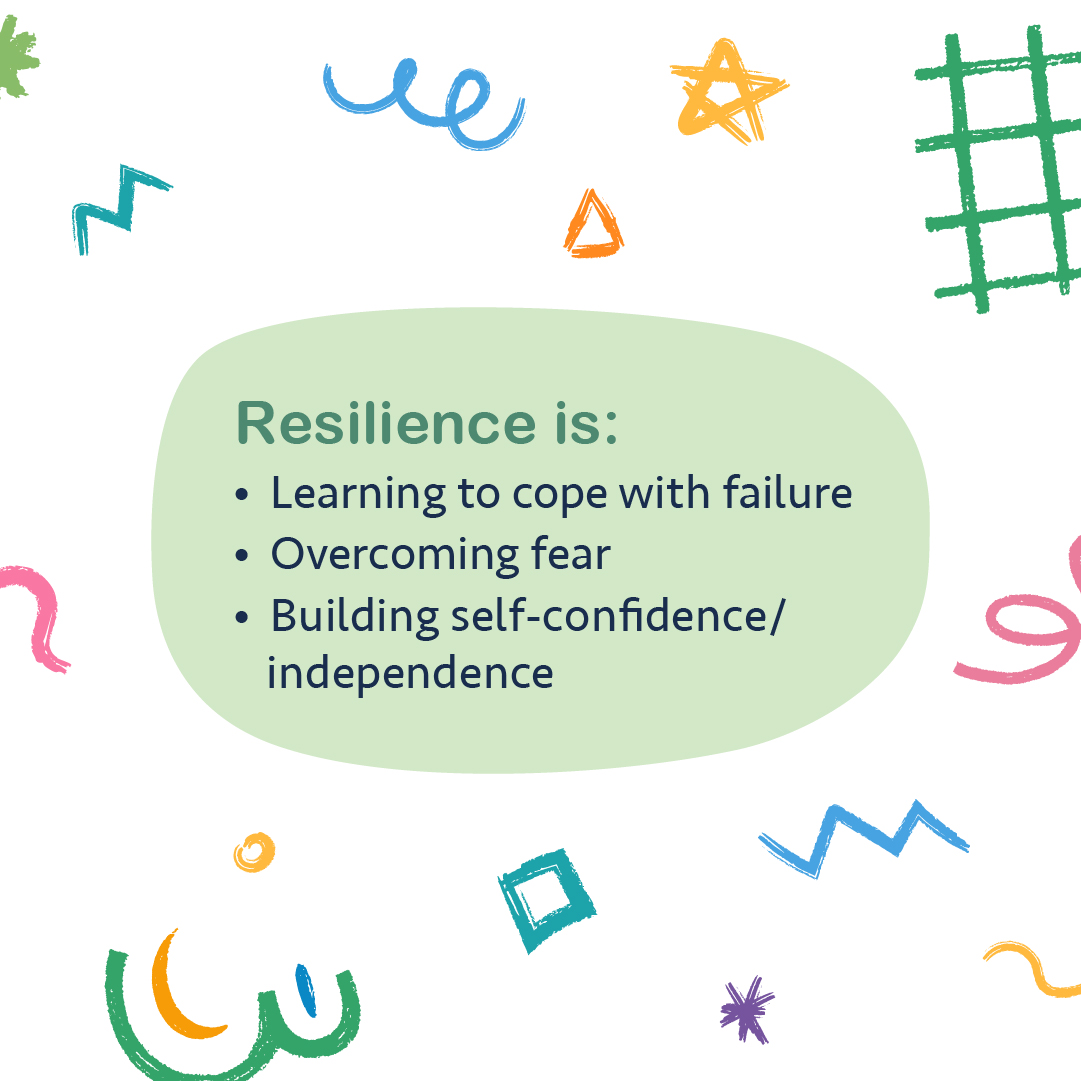

"Raise more resilient children through play...watch and see how your child handles challenging tasks without intervening right away." —Dr. Michelle Bauer
Building resilience through play
How can parents help their children build resilience? By letting them play!
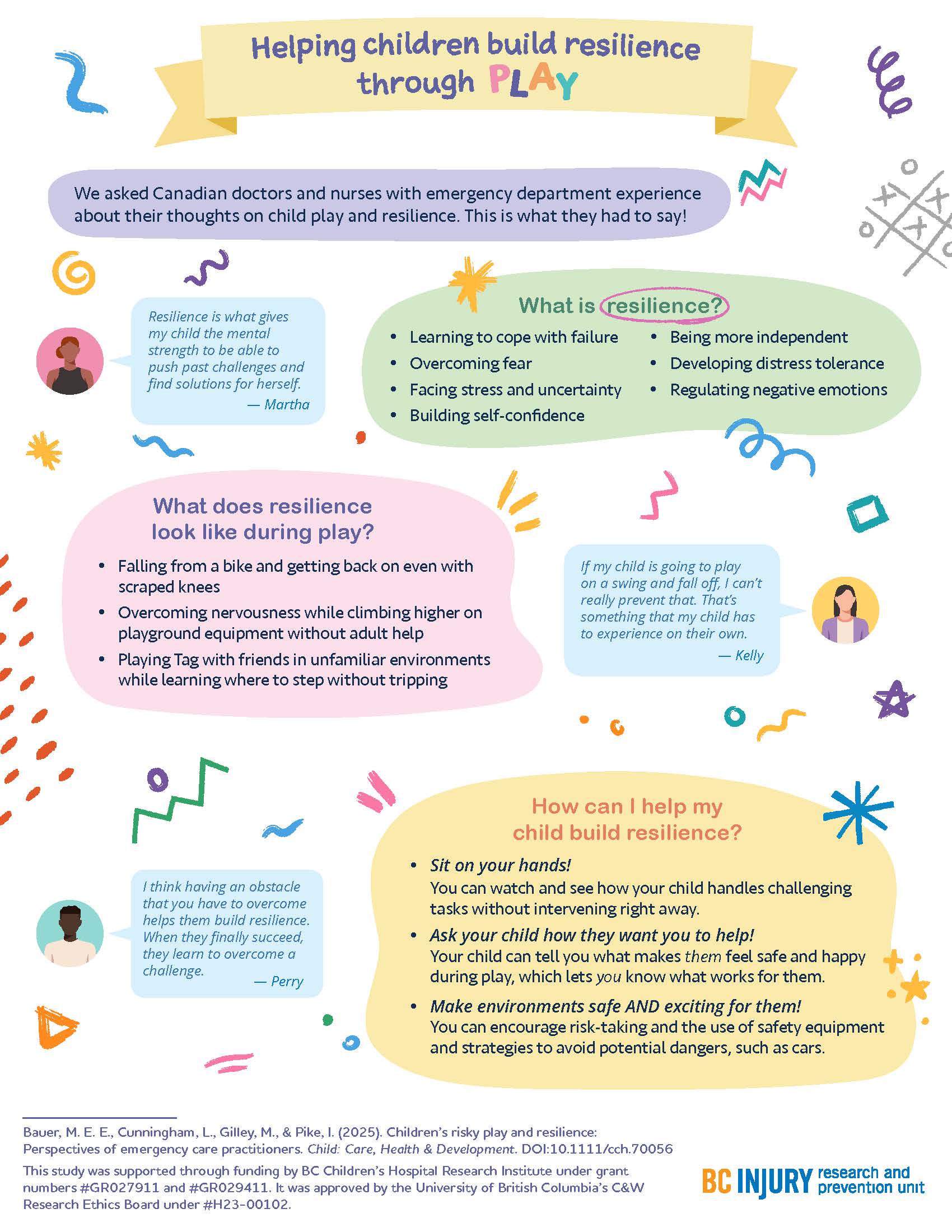
The experiences that practitioners witnessed encouraged them to support their children in building resilience through play; specifically, by supporting children in learning to cope with failure, overcome fear, build self-confidence, develop distress tolerance, and regulate negative emotions. Findings related to building resilience through play were published in the journal Child: Care, Health, and Development.
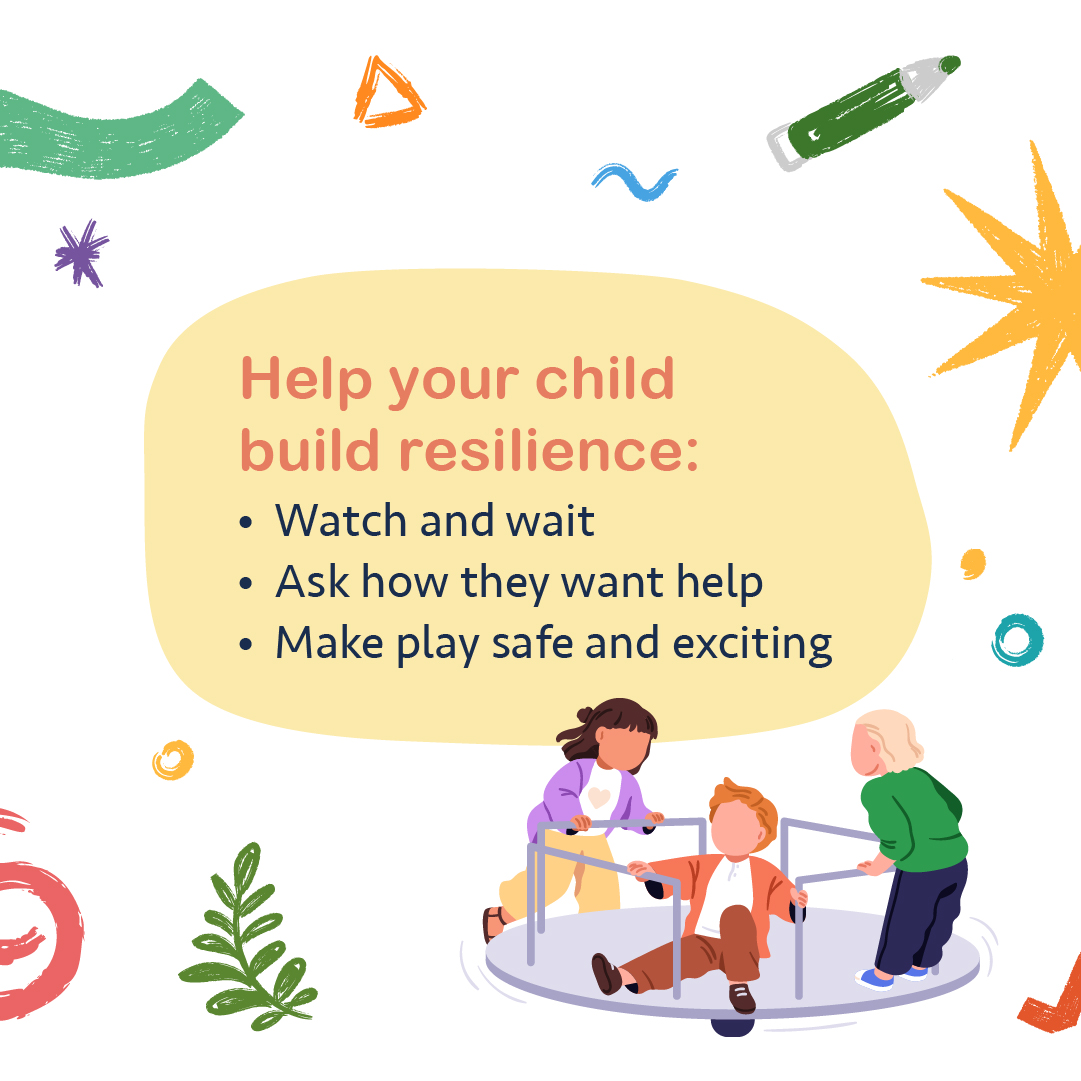
Parents fostered resilience in their kids by:
- helping their kids get back on bikes after they fell off and wanted to try again;
- sitting on their hands so they did not instinctively reach for their children when their children fell down; and
- encouraging participation in challenging and thrilling activities in forests and water while safety equipment was used.
"There are a few ways that parents can raise more resilient children through play that are supported by literature and our study findings," said Dr. Bauer. "One: watch and see how your child handles challenging tasks without intervening right away."
"Two: Ask your child how they want you to help—let them tell you what makes them feel safe and happy during play. Let them lead. And three: make play both safe and exciting by encouraging risk-taking, teaching them how to avoid hazards, and using safety equipment.”
This research was supported through Drs. Bauer’s and Gilley’s receipt of a clinical and translational research seed grant from the BC Children’s Hospital Research Institute (BCCHR), Dr. Bauer’s BCCHR postdoctoral fellowship award, and additional training provided to Dr. Bauer through her participation in the Programs and Institutions Looking to Launch Academic Researchers (PILLAR) program through ENRICH, a national organization training perinatal and child health researchers.
Learn more about the study through two infographic posters:
Graphics and posters by Milica Radosavljevic


