Attention
We are currently updating our website. Please excuse any inconsistencies in our content or temporary disruptions during this time. Thank you.
We are currently updating our website. Please excuse any inconsistencies in our content or temporary disruptions during this time. Thank you.
Electric kick scooters (e-scooters) are growing increasingly popular all around the world, and are a sustainable form of transportation. E-scooter riders are considered vulnerable road users, and there are steps that both riders and motor vehicle occupants can take to reduce the risk of injury.
E-scooters are a fun and convenient form of micromobility. They encourage independence, they can reduce congestion on roads, get people around more quickly, and have a lower impact on the environment.
The province of British Columbia (BC) is currently piloting the use of e-scooters in participating communities. Although a licence is not required, there are some restrictions on who can ride an e-scooter and where.
These restrictions include the following:
Participating municipalities are allowed to set their own rules (e.g., whether they allow the use of shared e-scooters).
The current hospitalization data are likely to be an underestimate of the number and cause of e-scooter injuries. This is because when e-scooters were introduced in BC, there was no way to identify an e-scooter-related injury using the data coding system for emergency department visits and hospitalizations. Prior to 2022, these injuries were coded using generic codes for either a fall, for a transport/motor vehicle incident grouped with injuries involving other types of scooters, or as a pedestrian injury. In recent years, coding for e-scooter related injuries was introduced; however, it takes time to adopt new injury coding practices across hospitals. While trauma centres collect data on e-scooter injuries, these reflect the most severe incidents and therefore are an underrepresentation of the total number of injuries.
However, e-scooter injuries can be identified in the Canadian Hospitals Injury Reporting and Prevention Program (CHIRPP) data if indicated by parents or caregivers during the visit to the CHIRPP hospital sites (BC Children’s Hospital and Kelowna General Hospital).
Data were recently analyzed for visits to BC Children's Hospital Emergency Department (ED) for e-scooter injuries among children and youth under 17 years of age, from April 1, 2025 to March 31, 2026:
Download our information sheet on e-scooter safety for children and youth (PDF).
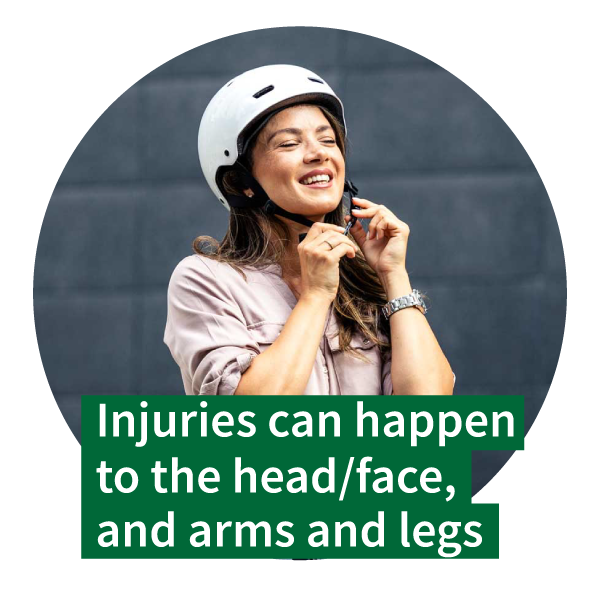
When riding an e-scooter, common areas of the body that can be injured include the head/face, and arms and legs. Causes of injury include falls, speeding, distraction, riding under the influence of drugs and/or alcohol, and not following the rules of the road.
E-scooters and e-bikes can travel faster than push scooters and pedal bikes. The faster you are going, the longer it takes you to stop, which could result in a higher velocity impact and more severe injury.
E-scooters have a higher centre of gravity than bikes. When someone falls off an e-scooter, they tend to fall forward over the handlebars, putting them at risk for head and facial injuries. An e-scooter's small wheels also make them vulnerable to bumps, rocks, and potholes on the road.
The Government of BC has a public education toolkit with posters and brochures about e-scooter safety available for download.
BCIRPU is working to provide the Ministry of Transportation and Transit (MoTT) with BC Children’s Hospital data related to e-scooters on an annual basis from now until 2028. The first two years of data have been provided to MoTT, and included the following variables: date and time of injury, sex, location, area, place, postal code, nature of injury, body part affected, safety equipment, and disposition. Learn more about this project on the BC Government website.
Canadian Hospitals Injury Reporting and Prevention Program (CHIRPP). April 1, 2025, to March 31, 2026.
BCIRPU. (July 31, 2023). YouTube. A safe system for e-scooters: The potential for injury prevention with a new form of micro-mobility. https://www.youtube.com/watch?v=cKCsAX1LgfU
Government of BC. (September 22, 2025). Electric kick scooter rules and safety. Available from https://www2.gov.bc.ca/gov/content/transportation/driving-and-cycling/cycling/electric-kick-scooter-rules
ICBC. (2025). Electric kick scooters and motorized skateboards. Available from https://www.icbc.com/vehicle-registration/specialty-vehicles/Low-powered-vehicles/Motorized-scooters-and-skateboards
ICBC (2025). Quick Statistics – Crashing Involving Pedestrians. 5-year average 2020-2024. Available from https://public.tableau.com/app/profile/icbc/viz/QuickStatistics-Crashesinvolving/CrashesInvolving
Robertson, R.D., et al. Traffic Injury Research Foundation. (July 2025). Micromobility in Canada: Risks, Regulations, Knowledge Gaps & Opportunities. Available from https://tirf.ca/projects/micromobility-canada/

The BC Injury Research and Prevention Unit is a leader in the production and transfer of injury prevention knowledge and the integration of evidence-based injury prevention practices in the daily lives of those at risk, those who care for them, and those with a mandate for public health and safety in British Columbia.
F508 – 4480 Oak Street
Vancouver, BC, V6H 3V4
Email: bcinjury@bcchr.ca